
The Hidden Cost of Fake Leads: How Much Junk Signups Drain Your ROI
Fake leads are a silent parasite draining your marketing budget. This guide breaks down the $32,000 productivity loss per rep and provides a playbook to clean your funnel.
Your marketing dashboard is likely lying to you. A growing lead count often signals a collapsing yield rather than a booming business.
Junk leads are a marketing black hole that drains your ROI to zero for every fraudulent dollar spent. We have moved past the era where volume is a metric of success.
Raw MQL counts frequently hide a pipeline that is fundamentally broken. When you focus on quantity alone, you invite bots and click farms into your ecosystem.
Lead generation sources must be held accountable for the quality of the data they provide. If a source provides 1,000 leads but zero revenue, the cost per lead is effectively infinite.
This is not just noise in the system. It is a strategic drain that rewards bad actors while starving your sales team of real opportunities.
Bottom Line: The Real Cost of Junk Signups
The math of lead fraud is brutal. You are likely losing 22% of your digital ad spend to fraudulent activity every year.
A single fake lead costs $32,000 per sales representative annually in lost productivity. This is not a rounding error; it is a direct tax on your growth.
- 79% of marketing leads never convert to sales.
- Only 25% of leads are truly legitimate and worth a follow-up.
- 550 hours are lost per rep each year chasing ghosts.
Cleaning your funnel is the fastest way to increase your revenue velocity without spending a single extra dollar on ads.
What Exactly Is a Fake Lead?
A fake lead is any form submission generated by a bot, click farm, or person using fraudulent data. These entries have zero intent to purchase and exist only to drain budgets.
Lead fraud is a systematic fabrication of interest designed to inflate commissions or sabotage competitors. It is a professional operation, not just a few random spam emails.
Rule: Treat every unverified email as a financial liability until it is proven to be a human asset.
Recent data suggests that 9% of emails entered on webforms are inherently invalid. This means nearly one out of every ten signups is a waste of resources before you even hit send.
Distinguishing between a 'bad' lead and a 'fake' lead is vital. A bad lead might just be the wrong persona, but a fake lead is a technical exploit of your marketing spend.
The Financial Impact: Calculating the $32,000 Productivity Tax
The $32,000 productivity tax is calculated by looking at the 550 hours a year your team spends on junk. When your reps spend a third of their time fixing contact info, your CAC jumps by a third.
Sales reps spend up to 70% of their week on non-selling tasks. Chasing fake leads is the most demoralizing part of that wasted time.

Consider a sales rep named Sarah at a mid-market SaaS company. She spends two hours every morning calling numbers that don't exist and emailing disposable domains.
By the time she reaches a real prospect, her energy is gone and she is behind on her daily quota. This human consequence leads to burnout and high turnover rates in high-growth companies.
The ROI of an invalid click is always 0:1. There is no world where a bot becomes a customer, yet we continue to pay for those clicks as if they were gold.
550 Hours Average time lost per sales/marketing rep each year chasing fake leads.
CRM Poisoning and the 'Trust Tax'
When bad data enters your CRM, it doesn't just sit there. It poisons your entire go-to-market strategy by skewing your analytics and attribution models.
50% of businesses lose new sales because their CRM data is riddled with errors. You cannot make smart decisions based on a database of ghosts.
Pitfall: Ignoring high bounce rates from 'fresh' leads can permanently tank your domain reputation and inbox placement.
High bounce rates from fake signups can drop your email inbox placement by 20-30%. Your real customers stop seeing your emails because the bots triggered spam filters.
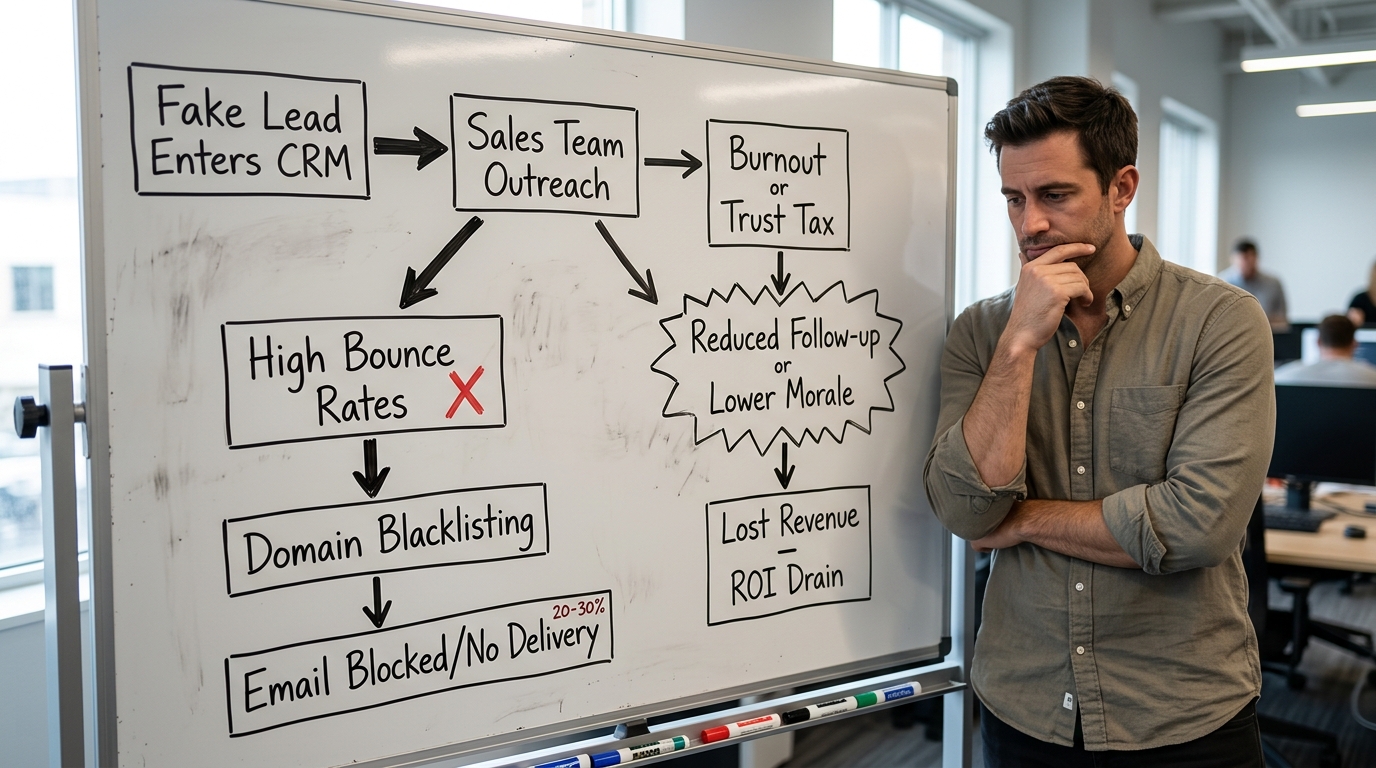
Then there is the 'Trust Tax.' This occurs when sales reps stop following up on marketing leads because they expect the data to be garbage.
Reputation damage is incredibly difficult to fix once it sets in. You might save your domain, but rebuilding the bridge between sales and marketing takes months of perfect data.
How to Audit Your Funnel for Fraud
You cannot fix what you do not measure. Auditing your funnel requires looking past the surface-level metrics provided by your ad platforms.
Cross-reference your CRM data with your email bounce logs. Any source that generates a high percentage of immediate bounces is a fraud risk.
- Audit 'Smart Bidding' algorithms to ensure they aren't learning from bot conversions.
- Switch from tracking raw MQL volume to Lead Velocity Rate (LVR).
- Monitor 'hesitation' and scrolling patterns on your web forms using session recording.
- Identify clusters of signups from the same IP range or data center providers.
- If your CPL is low but your close rate is dropping, investigate bot patterns immediately.
- If more than 10% of leads are non-responsive, shift your optimization focus from 'Identity' to 'Intent'.
- If email open rates drop despite clean content, check for domain reputation damage caused by junk signups.
True optimization happens at the revenue level, not the signup level. Bots can trigger every tracking pixel you have, but they cannot sign a contract.
The Protection Stack: Tools to Block Junk Signups
Standard CAPTCHAs are no longer enough to stop modern fraud. Agentic AI now mimics human browsing behavior, including hesitation and scrolling, making basic hurdles obsolete.
You need a real-time protection stack that validates the person behind the screen before they ever hit your CRM. This starts at the form level.

Tools like IsFakeMail provide real-time disposable email detection. This prevents users from using temporary burner addresses to exploit free trials or lead magnets.
For technical bot prevention, specialized services like CHEQ Form Guard or Spider AF offer deeper protection against invalid traffic. These tools sit between your ads and your budget.
Implementing DMARC and BIMI will also help protect your email deliverability. This ensures your legitimate emails aren't punished for the behavior of a few bad leads.
Integration of an API-based validation service like IsFakeMail is often the easiest first step. It requires no authentication and responds in under 50ms using Cloudflare KV technology.
Summary: Direct vs. Hidden Costs of Fake Leads
Understanding the difference between what you see on an invoice and what you lose in growth is essential. Some costs are obvious, while others are invisible until your growth stalls.
| Cost Category | Direct Financial Cost | Strategic Hidden Cost |
|---|---|---|
| Ad Spend | Statista predicts $133B+ loss | Algorithmic training on junk traffic |
| Productivity | Wasted hourly wages for reps | Salesforce reports rep burnout |
| Brand Equity | Higher Cost Per Lead (CPL) | 25% customer loss after fraud events |
| Technology | CRM storage and seat costs | 20-30% lower email deliverability |
The return on ad spend for invalid traffic is zero. Every dollar spent on a fake click is a dollar taken away from a real customer acquisition.
Frequently Asked Questions About Lead Fraud
What is the most common sign of lead fraud?
The most common sign is a high volume of signups that never engage with follow-up emails or calls. If your Cost Per Lead is dropping while your Sales Qualified Lead (SQL) rate is also dropping, you likely have a fraud problem.
How does bad data affect email deliverability?
When you send emails to fake or disposable addresses, they bounce. High bounce rates signal to providers like Gmail and Outlook that you are a spammer, which causes your legitimate emails to be sent to the spam folder according to DiscoverOrg.
Why are CAPTCHAs failing to stop bots?
Modern bots use AI to solve puzzles and mimic human mouse movements. Advanced 'Agentic AI' can even navigate complex web flows, making it necessary to use behavioral analysis and email verification instead of just visual puzzles.
Is it possible to get a refund for fraudulent ad clicks?
Most major platforms have systems to detect and refund invalid traffic, but they often miss sophisticated lead fraud. You must provide your own data logs and evidence of bot activity to successfully dispute these charges.
What are disposable email addresses?
These are temporary, burner accounts that expire after a few minutes or hours. They are frequently used by bots or 'freebie hunters' who have no intention of becoming long-term customers.
Stop Chasing Volume, Start Chasing Revenue
Stopping lead fraud is not about adding friction; it is about adding intelligence. When you clean your funnel, you give your sales team their time back.
Shift your optimization from 'Identity' to 'Intent'. Do not just verify that an email exists; verify that a person actually wants to solve a problem.
Align your sales and marketing teams on Product Qualified Lead (PQL) thresholds. This ensures that only the most engaged and verified prospects move into the sales pipeline.
Cleaning your CRM will feel like an immediate revenue boost. Your reps will be more confident, your deliverability will improve, and your ROI will finally reflect the truth.
Stop chasing the volume mirage. Start protecting your budget and your people by blocking the junk at the door.