
How Disposable Emails Skew Your SaaS Trial-to-Paid Conversion Metrics
Disposable email addresses are creating a 'denominator inflation' crisis for SaaS founders. Discover the math behind the 42% CAC premium and how to clean your funnel.
You hit launch and the notifications start rolling in. Fifty signups in the first hour feel like a massive win for your new SaaS feature.
By the next morning, the excitement vanishes when you realize half of those signups are ghosts that never clicked a single button.
Disposable email addresses (DEAs) are the silent killers of early-stage growth. These temporary mailboxes allow users to exploit your free trial or grab your lead magnet without giving you a way to follow up.
The user didn't lose interest; the user never existed.
You aren't just looking at bad data. You are looking at a system that is actively leaking money while making your marketing team look like they are failing.
The Bottom Line on Disposable Email Impact
- 20% to 30% of freemium signups are typically fake or disposable accounts.
- A 30% leak in lead quality results in a 42% premium on your real CAC.
- Exceeding a 2% hard bounce rate risks ISP throttling and domain blacklisting.
- Maintaining a clean database prevents you from overpaying for inflated CRM tiers.
The Math of Denominator Inflation: Why Your Data Is Lying to You
When your database is full of temporary addresses, every metric you track becomes a lie. This is called denominator inflation.
If you have 1,000 signups and 50 sales, your conversion rate looks like a modest 5%. If 300 of those signups were disposable emails, your real conversion rate is actually 7.1%.
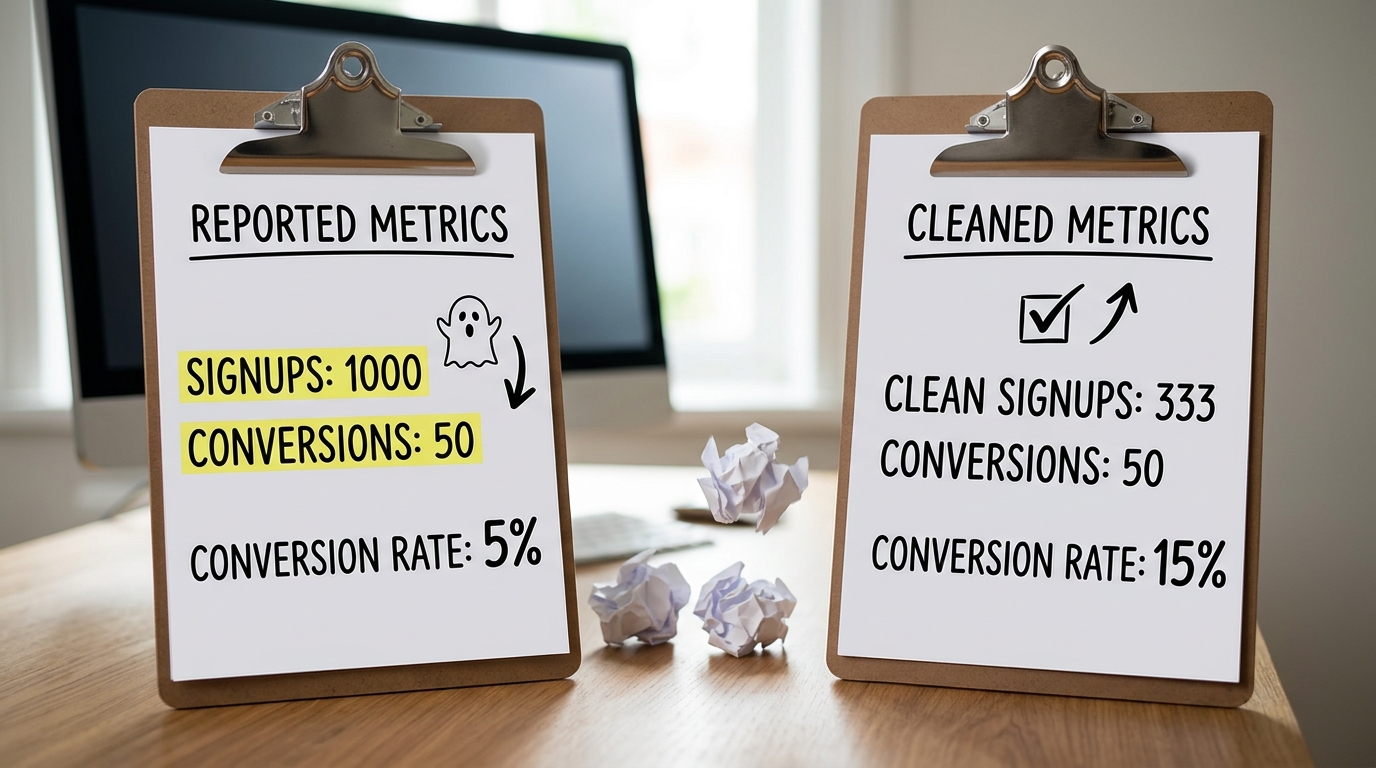
You might spend months optimizing a landing page that is actually performing well. The problem is not the copy or the offer; it is the fact that your math is being sabotaged by users who never intended to stay.
42% premium paid on CAC when 30% of leads are non-converting fakes.
Example
A SaaS platform launched a free tier and celebrated a spike in volume. They later found 30% of signups were from burner domains like guerrillamail.com. This created a hidden premium on their real CAC and forced them into a higher HubSpot billing tier for thousands of users who would never convert.
Beyond the math, these ghosts eat your budget. Services like Intercom and HubSpot charge based on contact counts, meaning you are subsidizing the storage of garbage data.
The Hidden Threat to Deliverability and Sender Reputation
Sender reputation functions exactly like a personal credit score. Every time you send an automated onboarding email to a dead mailbox, your reputation takes a measurable hit.
When you hit a disposable address that has already expired, you get a hard bounce. If your hard bounce rate exceeds 2%, major providers like Gmail and Outlook will start throttling your delivery or sending your emails straight to spam.
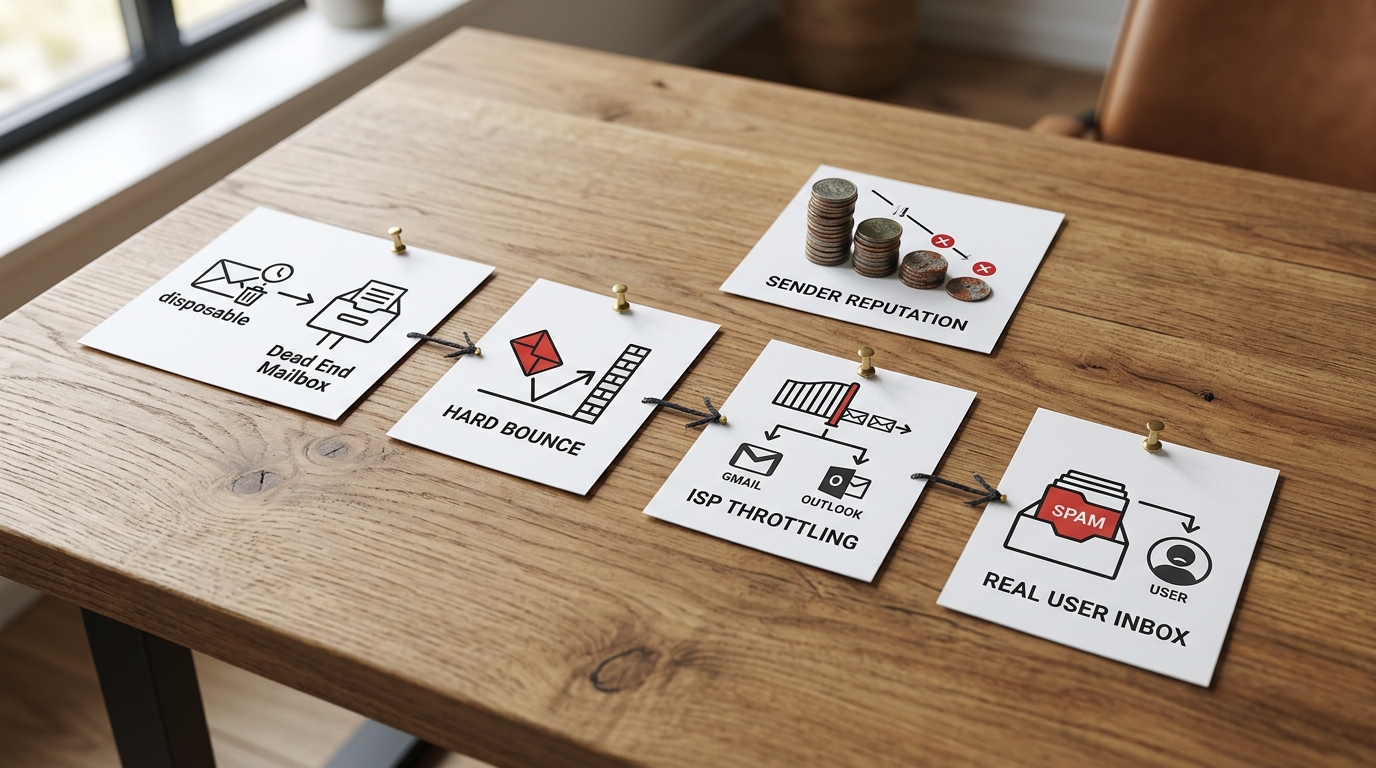
This creates a cycle of failure. Your emails stop reaching real customers because your sender score is tanked by fakes.
Pitfall: Using complex regex to validate emails usually fails to catch newly created burner domains and often blocks legitimate users.
B2B lists already decay at a rate of 22.5% per year due to job changes. Adding a flood of disposable emails on top of that natural decay makes long-term deliverability nearly impossible to maintain.
Rule: Never treat Apple's 'Hide My Email' as a disposable burner; these are legitimate users protecting privacy, not ghosts.
How to Stop the Leak: A 5-Step Prevention Playbook
Stopping the leak requires a mix of technical barriers and user psychology. You want to make it easy for real users to join while making it impossible for bots to squat in your CRM.
- Integrate a real-time verification API. Use a service like IsFakeMail to check emails at the moment of signup. If the domain is disposable, the system should block the submission immediately.

- Optimize your UX messaging. Instead of a generic error, tell the user exactly why they are blocked. Use a message like: Please use a permanent email to ensure you receive your access credentials and account updates.
- Use Double Opt-in (DOI). This is the ultimate filter for inbox access. Users who use a 10-minute mail service often abandon the process before they can even click the confirmation link.
- Scrub your CRM quarterly. Use a bulk cleaning tool to remove expired domains and dead accounts. This keeps your deliverability high and your CRM costs low.
- Monitor IP velocity. If you see 50 signups from the same IP address in five minutes, you are likely facing a bot attack. Implement rate limiting to protect your infrastructure.
To build a basic check in a Node.js environment, you can use a simple fetch call to a verification endpoint during the form validation phase.
// Example using IsFakeMail API
async function validateEmail(email) {
  const response = await fetch(`https://api.isfakemail.com/v1/check/${email}`);
  const data = await response.json();

  if (data.disposable) {
    // block the signup and show a message to the user
    return false;
  }
  return true;
}
- Integrate API at the point of capture
- Use friendly but firm UX copy
- Require email confirmation before account access
- Perform quarterly database cleanups
- Track signup velocity to catch bot clusters
If you need a deep dive on how these fakes impact your bottom line, this guide provides an excellent starting point:
- If your hard bounce rate is over 2%, implement real-time API blocking immediately.
- If you serve a privacy-conscious audience, allow forwarding services but block burners.
- If your CAC is climbing without a change in ad spend, audit your list for disposable domains.
Evaluating Prevention Methods: Friction vs. Accuracy
| Prevention Method | Price | Best For | Pros |
|---|---|---|---|
| Real-time API | Free to Low | SaaS Signups | High accuracy; identifies new domains instantly |
| Static Blacklists | Zero | Resource-strapped teams | No cost; easy to implement initially |
| Double Opt-in | Zero | Content Marketing | Verifies inbox access; low technical overhead |
| Upfront Credit Card | High | High-Value Trials | Eliminates casual abusers; proves high intent |
You can find more details on these benchmarks in the SaaS Email Benchmark Report.
Top Tools for DEA Detection and List Hygiene
IsFakeMail
IsFakeMail is a free real-time disposable email detector designed for developers who need to protect their platforms without a complex setup. It provides a REST API that checks against a database of over 187,000 known domains. The service is optimized with Cloudflare KV for sub-50ms response times, making it ideal for high-traffic signup forms.
ZeroBounce
ZeroBounce offers comprehensive email verification and list cleaning services for large enterprises. Their system checks for spam traps, bounces, and disposable addresses while providing detailed API documentation for integration. One tradeoff is that its feature-rich nature can be more expensive than simpler detection tools.
NeverBounce
NeverBounce specializes in real-time validation for forms and bulk list cleaning. It is a reliable choice for teams that need to verify large batches of legacy data before starting a new marketing campaign. However, the interface can feel slightly cluttered for users who only need a quick domain check.
Bouncer
Bouncer focuses on list hygiene and deliverability by verifying emails across multiple stages. It provides a simple API and a toxicity check that identifies potentially harmful addresses. A potential downside is that the initial setup for custom rules can take more time than automated alternatives.
Clearout
Clearout is a SaaS-focused form guard that prevents fake registrations and improves lead quality. It integrates directly with common marketing tools to automate the cleaning process as users enter the funnel. The tradeoff is that it primarily targets marketing teams rather than developers looking for raw API access.
Frequently Asked Questions About Disposable Emails
Why shouldn't I just use a regex to block fakes?
Regex is great for checking the format of an email (like making sure it has an @ symbol). It cannot tell you if a domain was created five minutes ago specifically to bypass your signup gate. Specialized APIs track thousands of new domains daily, which is impossible to keep up with using static code.
Does blocking disposable emails hurt my conversion rate?
It will lower your total number of signups, but it will increase your conversion-to-paid rate. You are removing the denominator inflation that makes your product look less successful than it actually is.
Is Apple's 'Hide My Email' considered a disposable address?
No. Apple's service is a privacy-focused relay that forwards mail to a real, permanent inbox. These users have high intent and should be allowed. True disposable emails use temporary mailboxes that self-destruct after a short period, making follow-up impossible.
Can I just block all free providers like Gmail?
Only do this if you are strictly B2B and only want work emails. For most SaaS companies, blocking Gmail or Outlook kills legitimate conversions from freelancers, students, and early-stage founders.
Stop Subsidizing the Ghosts in Your Database
Cleaning your funnel isn't about being restrictive; it is about protecting your data integrity. When you remove the ghosts, you stop paying a premium for fake growth.
Your next step is to audit your last 30 days of signups. If you see domains like 10minutemail.com or guerrillamail.com, it is time to plug the leak.
Once you implement a real-time check, you will see your bounce rates drop and your sales team's morale rise. Stop subsidizing the ghosts and start building for real people.