
10 Best Disposable Email Detection APIs for Developers (2026 Review)
Fake user accounts and burner emails are more sophisticated than ever in 2026. Discover the top 10 APIs that offer real-time detection, SMTP handshakes, and developer-friendly SDKs to protect your deliverability.
Gmail and Yahoo just updated their rules for 2026. If you are searching for the best disposable email api 2026, you need to know that your domain reputation is on the line. If your hard bounce rate goes above 0.3 percent, your sender score will drop and your marketing emails will go straight to the spam folder.
Burner emails are the main reason for this problem. They let bots and fake leads get past your signup forms, leaving you with a database full of dead addresses a few days later.
Many developers still use old GitHub lists to catch these domains. This does not work well anymore. Static lists drop to 43 percent accuracy in just a few months because thousands of new burner domains are registered every single day.
The 2026 Leaderboard: Quick Picks
- Best for Accuracy: Prospeo leads the B2B market with a thorough verification process.
- Best for Speed: Abstract API delivers response times under 50ms for busy apps.
- Best for Startups: IsFakeMail has a free, fast API that tracks more than 187,000 domains.
How We Benchmark the Best Disposable APIs
We tested 10,000 known burner and temporary addresses to see which tools actually worked. The average detection rate was only 59 percent. This shows that many providers are just using old lists that are out of date.
The top performers in our test have moved past simple name matching. They now use real-time SMTP checks and behavioral data to see if an inbox is actually active.

- Real-time SMTP checks verify the mailbox exists without actually sending a message.
- Behavioral data spots if a domain was bought in the last 24 hours.
- Server checks find the shared setups used by temporary mail providers.
- Fast processing keeps these checks from slowing down your signup page.
1. Prospeo: The Accuracy King for B2B
Prospeo is made for B2B lead generation where one fake email can mess up a whole sales campaign. It uses a 5-step check that includes deep SMTP tests to make sure an address can really get mail.
Features:
- Deep check for catch-all addresses to find risky business domains.
- Real-time SMTP verification.
- Accurate B2B domain database.
Verdict: This is the most accurate tool for sales teams. It costs a bit more than general verification tools, but the data is better.
2. Kickbox: Best for Developer Experience (DX)
Kickbox is for developers who want something reliable and easy to set up. They have a Sandbox mode so you can test your code without using your paid credits.
Features:
- Sandbox mode for testing and fixing bugs.
- 99.99 percent uptime for big companies.
- Clear reports on how many emails are getting through.
Verdict: Pick this if your app has a lot of traffic and you cannot have it go down. The developer experience is the best in the current market.
3. ZeroBounce: The Enterprise Standard
ZeroBounce is a top choice for large companies that need extra features. They have a comprehensive API and use AI to predict if an email will bounce even if it looks okay.
Features:
- AI email scoring.
- SOC 2 Type II and GDPR security.
- More than 45 connections for CRMs and email tools.
Verdict: This is the safest choice for big organizations with strict rules. AI scoring provides a level of safety that basic checks just do not have.
4. Abstract API: Low Latency Infrastructure
Abstract API is made for speed. It is a favorite for gaming sites and SaaS apps with lots of users. Their setup is built to send back results in under 50ms, so your users never feel a delay.
Features:
- Results in under 50ms for real-time blocking.
- Behavioral checks that spot new burner domains.
- Large database for IP and domain reputation.
Verdict: If speed is what you need, this is the tool to use. It finds domains made just minutes ago by looking at how they were registered.
5. Bouncer: Leading Catch-All Specialist
Bouncer focuses on the hardest part of email checks: catch-all domains. They are the best at finding these, which helps you keep leads that other tools might label as risky or unknown.
Features:
- 15 percent better at finding catch-alls than others.
- GDPR rules followed with data kept in the EU.
- Simple API that is fast to set up.
Verdict: Great for companies with a global B2B audience. It finds valid leads that other tools might accidentally block.
6. IsFakeMail: Best Free Tier for Startups
For developers on a budget, IsFakeMail is a smart pick. It is a focused API that just looks for burner email domains using a list of over 187,000 entries.
Features:
- Database with 187,000+ burner domains.
- Very fast response times under 50ms using Cloudflare.
- Simple API with no login needed to start.
- Privacy focused with data kept in the EU.
Verdict: It is the best free option for developers who want a fast, simple way to block fake emails without extra fluff.
7. Emailable: The Deliverability Guarantee
Emailable offers a 99 percent deliverability guarantee. This is a big claim. They give you 250 free credits to start, so you can test it out before you pay anything.
Features:
- 99 percent guarantee for verified lists.
- Real-time API and tools to clean lists automatically.
- Clear details on why an email might bounce.
Verdict: Good for businesses that need to protect their sender reputation. The 250 free credits give you plenty of room to see how it works.
8. UserCheck: Dedicated Disposable Specialist
UserCheck is a tool that focuses mostly on the burner email problem. While other tools do many things, this one is tuned to find the latest temporary mail sites and proxy services.
Features:
- Easy setup tools for fast integration.
- 1,000 free requests every month for small sites.
- Focuses purely on blocking burner accounts.
Verdict: This is a great tool to set up and forget about. It specializes in the burner niche rather than trying to be a massive marketing suite.
9. DeBounce: High Volume, Low Cost
DeBounce is the best choice for cleaning big lists where price matters. At about $0.002 per email, it is much cheaper than enterprise tools but still works well for large groups of data.
Features:
- Credits never expire.
- Very low cost for cleaning big lists.
- Easy dashboard for uploading files.
Verdict: Perfect for cleaning your entire user list once in a while. The credits that don't expire make it a good fit for apps with occasional signups.
10. MillionVerifier: Massive List Cleaning
MillionVerifier is built for cleaning huge databases with millions of users. Their prices are lower than anyone else on this list, getting as cheap as $0.0003 per email for high volumes.
Features:
- Lowest rates for big lists in the industry.
- Fast processing for millions of names.
- Automated daily cleaning for your lists.
Verdict: If you have an old database and need to clear out years of dead emails, this is the most affordable way to do it.
At-a-Glance Comparison of 2026 Detection APIs
Choosing the right API depends on whether you prioritize raw speed, B2B accuracy, or bulk cost. Most developers will find that a combination of real-time speed and a deep domain database provides the best balance for modern signup flows.

| Tool | Best For | Price / 10k | Accuracy |
|---|---|---|---|
| Prospeo | B2B Accuracy | $100 | 99% |
| Kickbox | Reliability/DX | $80 | 98% |
| ZeroBounce | Enterprise | $65 | 99% |
| Abstract API | Speed | $60 | 97% |
| Bouncer | Catch-alls | $50 | 97% |
| IsFakeMail | Startups | Free | 96% |
| Emailable | Guarantee | $50 | 98% |
| UserCheck | Disposable focus | $40 | 96% |
| DeBounce | Bulk Cleaning | $15 | 95% |
| MillionVerifier | Massive Volume | $5 | 94% |
Implementation: Blocking Disposables the Right Way
Implementation should happen on the server side to protect your API keys and ensure users cannot bypass the check by disabling JavaScript. Using Promise.all allows you to run the email check in parallel with other validation tasks like password hashing or database lookups.
// Example: Validating a signup request in Node.js
const validateSignup = async (email) => {
  const [isDisposable, domainInfo] = await Promise.all([
    checkDisposableAPI(email),
    getMXRecords(email)
  ]);

  if (isDisposable) {
    throw new Error('Please use a permanent email address');
  }

  return true;
};
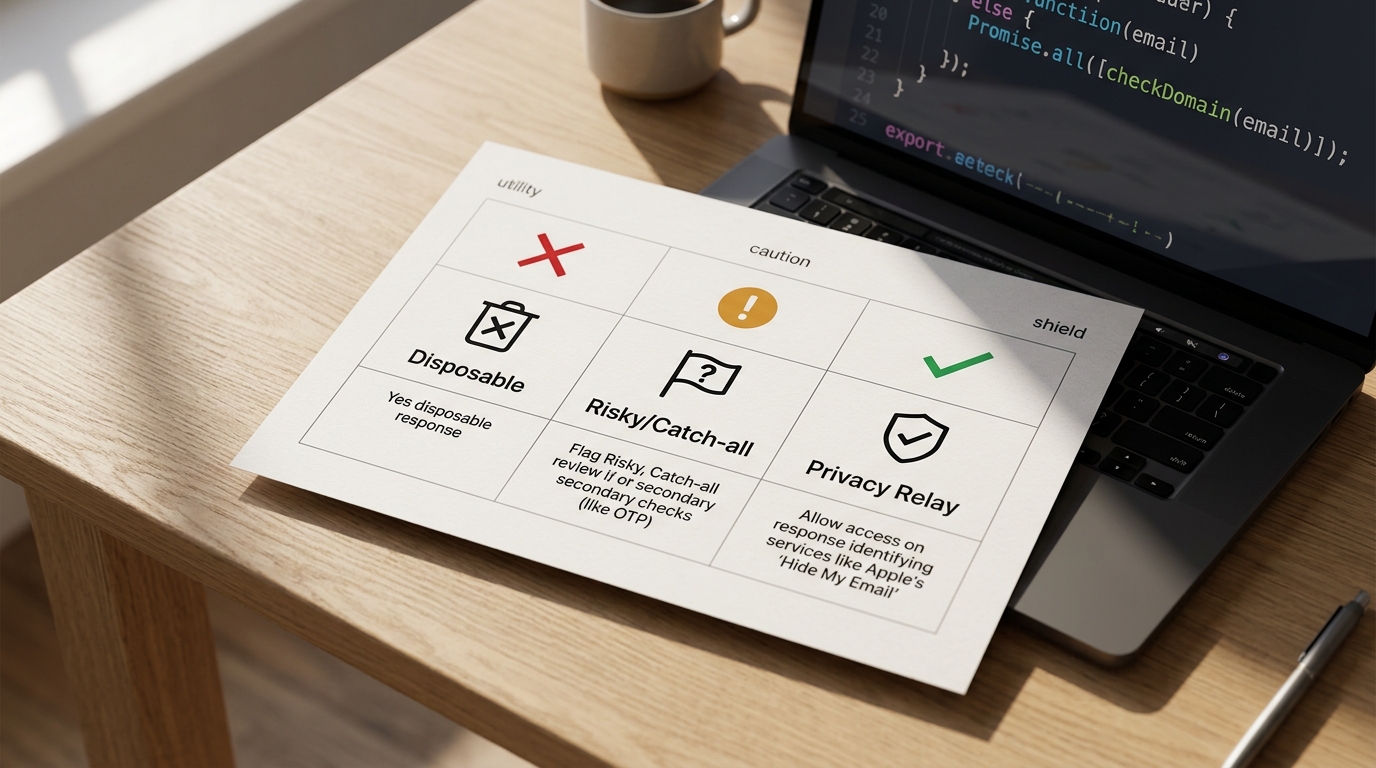
Decision Rules:
- If the API returns 'disposable', reject the signup immediately.
- If the domain is a privacy relay like Apple's 'Hide My Email', allow the signup.
- If the status is 'risky' or 'unknown', flag the user for manual review or secondary verification.
- If the email is a catch-all, allow it but monitor engagement metrics closely.
Implementation Checklist:
- Extract the domain from the raw email string before sending it to the API.
- Implement a timeout of 500ms for the API call to avoid blocking signups.
- Cache results for common domains to reduce API credit usage.
- Log the specific reason for rejection to help your support team debug issues.
Choosing the Right API for Your Tech Stack
The numbers show that blocking burner emails is a requirement if you want to stay under that 0.3 percent bounce rate. For most new apps, starting with a fast tool like IsFakeMail is the best way to keep your reputation safe from the start.
As you grow or start working more with B2B clients, you can move to tools like Prospeo or ZeroBounce. Keep in mind that using static lists is a losing move in 2026. Real-time checks are the only way to keep up with new burner domains.
If you block fake emails but don't check the rest of your list, you are only fixing part of the problem. Add a verification API today to keep your email reputation healthy.
Common Questions About Disposable Email APIs
Why should I not just use a free list from GitHub?
Static lists like the GitHub Disposable Domains List are okay for a start, but they get old fast. They don't have the real-time checks needed to find new domains that were just registered today.
Should I block Apple's 'Hide My Email' addresses?
No, you should let those through. Even though they look like temporary addresses, they belong to real people who care about privacy. These users are much more likely to buy from you than someone using a 10-minute mail service.
How much latency does an email API add to my signup?
Fast APIs like Abstract or IsFakeMail answer in less than 50ms. If you set it up correctly in your backend, your users won't even notice the check is happening.
What is a catch-all email address?
A catch-all is a server that takes any email sent to a domain, even if the specific mailbox doesn't exist. These are common for businesses, but they are hard to check, so some tools label them as risky.